


Industrial mobility equipment relies heavily on high-performance caster wheels, and poor-quality casters directly lead to frequent equipment failures, increased maintenance costs, unstable cargo transportation, and hidden safety hazards on production sites. Many factory managers only focus on unit prices when purchasing casters, ignoring core parameters such as wear resistance, shock absorption, noise reduction, and high-temperature resistance, which causes frequent wheel cracking, shaft jamming, and load deformation during long-term heavy-load operation. Choosing qualified and reliable heavy duty PU industrial casters can fundamentally avoid these common on-site faults and greatly extend the overall service life of handling carts, racks, and logistics equipment.
Most ordinary polyurethane casters on the market suffer from insufficient density, easy peeling of wheel surfaces, poor compression resistance, and short service life under continuous heavy pressure. When used in warehouses, workshops, logistics parks, and mechanical equipment matching scenarios, they quickly become flat, slip, or produce harsh friction noise. These seemingly minor problems gradually slow down production efficiency, increase manual maintenance workload, and even cause cargo dumping and personal injury accidents. Professional customized industrial casters from professional caster manufacturing enterprise adopt optimized formula and precision casting processes, perfectly solving the pain points that ordinary products cannot adapt to complex ground environments and long-time high-intensity operation.
Deeply analyzing the hidden problems behind caster damage, frequent rolling resistance changes are the primary factor affecting industrial handling efficiency. Uneven ground, gravel roads, cement floor wear, and frequent turning and braking will all accelerate internal structural fatigue of wheels. Low-hardness PU materials deform under pressure, increasing friction resistance and consuming more power for mobile equipment; excessively hard materials lack buffer performance, damage the ground, and vibrate violently during movement. Reasonable hardness matching and integrated wheel core design can balance ground adaptability, load stability, and motion smoothness at the same time.
Long-term heavy-load continuous operation exposes more hidden quality defects of inferior casters, including loose bearings, inflexible rotation, easy rusting of brackets, and insufficient bending resistance of wheel frames. In low-temperature, humid, oily, and dusty industrial environments, ordinary metal brackets corrode rapidly, bearing lubrication fails quickly, and wheels cannot rotate freely. Once stuck or offset during transportation, large-scale production line stagnation will occur. Standard heavy-duty PU casters integrate anti-corrosion treatment, sealed bearing structure, and reinforced thickened brackets, adapting to harsh working conditions all year round without frequent replacement.
Noise pollution and ground abrasion are easily overlooked long-term troubles in industrial workshops. Unqualified casters generate loud squealing friction noise when rolling, damaging the working environment and affecting employee concentration. At the same time, hard wheel bodies scratch and damage epoxy floors, cement floors, and anti-static floors, raising later floor repair expenses. High-density wear-resistant PU wheels have excellent silent rolling performance, soft contact force with the ground, no damage to various indoor and outdoor workshop grounds, and maintain stable quiet operation even under full-load high-frequency movement.
Core Performance Comparison Of Ordinary Casters & Premium Heavy Duty PU Casters
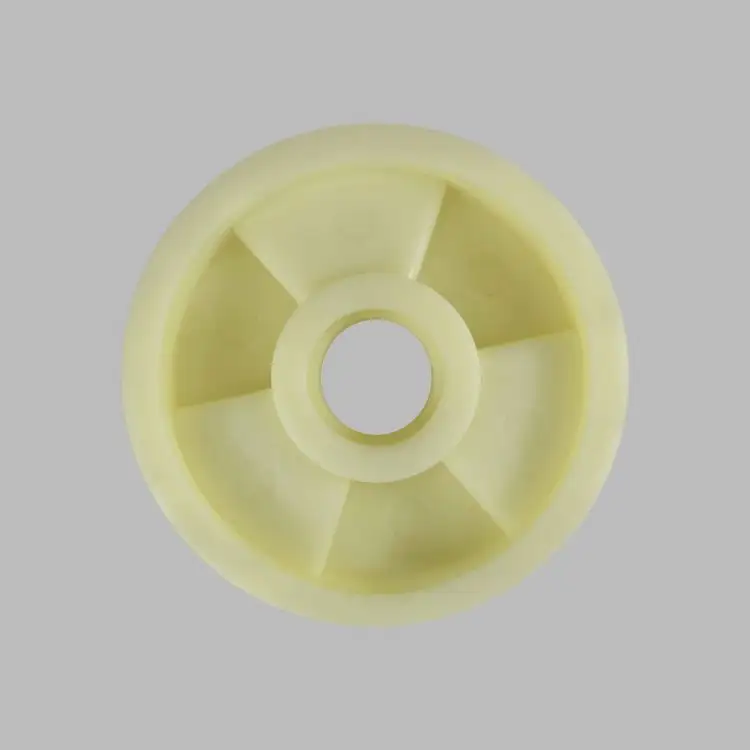
| Performance Indicator | Ordinary PU Caster Wheels | High Load Industrial PU Caster Wheels |
|---|---|---|
| Single Wheel Bearing Capacity | ≤300kg | 500kg–2000kg adjustable |
| Surface Wear Resistance | Easy peeling & cracking within 3–6 months | Stable use for 2–5 years |
| Ground Adaptability | Only suitable for flat smooth floors | Adapt to cement, gravel, epoxy, uneven industrial ground |
| Working Environment Tolerance | Poor oil resistance, poor low-temperature resistance | Oil-resistant, corrosion-resistant, moisture-proof, low-temperature resistant |
| Bearing Rotation Flexibility | Easy jamming and inflexible steering | Smooth 360° rotation, low rolling resistance |
| Bracket Service Life | Deformation and fracture under long heavy pressure | Thickened steel bracket, anti-bending and anti-shock |
Many users misunderstand that all polyurethane casters have the same wear-resistant and load-bearing effects, ignoring material formula differences, bracket thickness standards, bearing precision grades, and overall assembly processes. Unqualified finished products cut corners on raw materials, use thin iron brackets and ordinary ordinary bearings, and cannot withstand repeated heavy pressure impact. In contrast, professionally manufactured heavy-duty casters undergo strict load testing, pressure fatigue testing, wear resistance testing, and environmental aging testing before leaving the factory, ensuring consistent performance in actual complex working scenarios.
For logistics warehouses, mechanical equipment, mobile workbenches, tool carts, shelf vehicles, and automated handling equipment, matching appropriate load-grade casters is the key to reducing comprehensive operating costs. Blindly choosing overloaded or underloaded casters will cause premature aging of wheels, shortened equipment service life, and unnecessary frequent replacement costs. Reasonable caster selection can reduce daily maintenance frequency, lower labor consumption, stabilize on-site operation rhythm, and improve overall logistics and production turnover efficiency.
In actual application scenarios, anti-skid performance also determines operation safety. Wet workshop floors, oil-stained ground, and inclined passages all require casters with stable friction coefficients. High-quality PU materials have excellent anti-slip characteristics, avoid slipping and sudden sliding during braking and turning, effectively protect transported precision parts, bulk goods, and heavy equipment, and eliminate major safety hazards in mobile handling links.
To sum up, industrial caster selection is not a simple procurement choice, but a supporting plan related to production safety, operation efficiency and long-term cost control. By selecting standardized heavy-duty PU casters with reliable quality, reasonable parameters and complete environmental adaptability, enterprises can thoroughly solve frequent faults, high noise, short service life and unstable load problems, and build more stable, efficient and safe industrial mobile handling systems.